What Is Machine Learning? When Writing Another Rule Stops Working
Rewritten: . Rewritten with AI assistance. Examples and tool references follow the original publication period.
The first version of a spam filter can fit in one sentence: if an email contains “claim your prize,” send it to the spam folder.
Then a legitimate competition sends that phrase. A spammer writes “collect your reward.” Someone adds two more rules. A month later, the filter is a growing list of exceptions whose interactions are hard to predict.
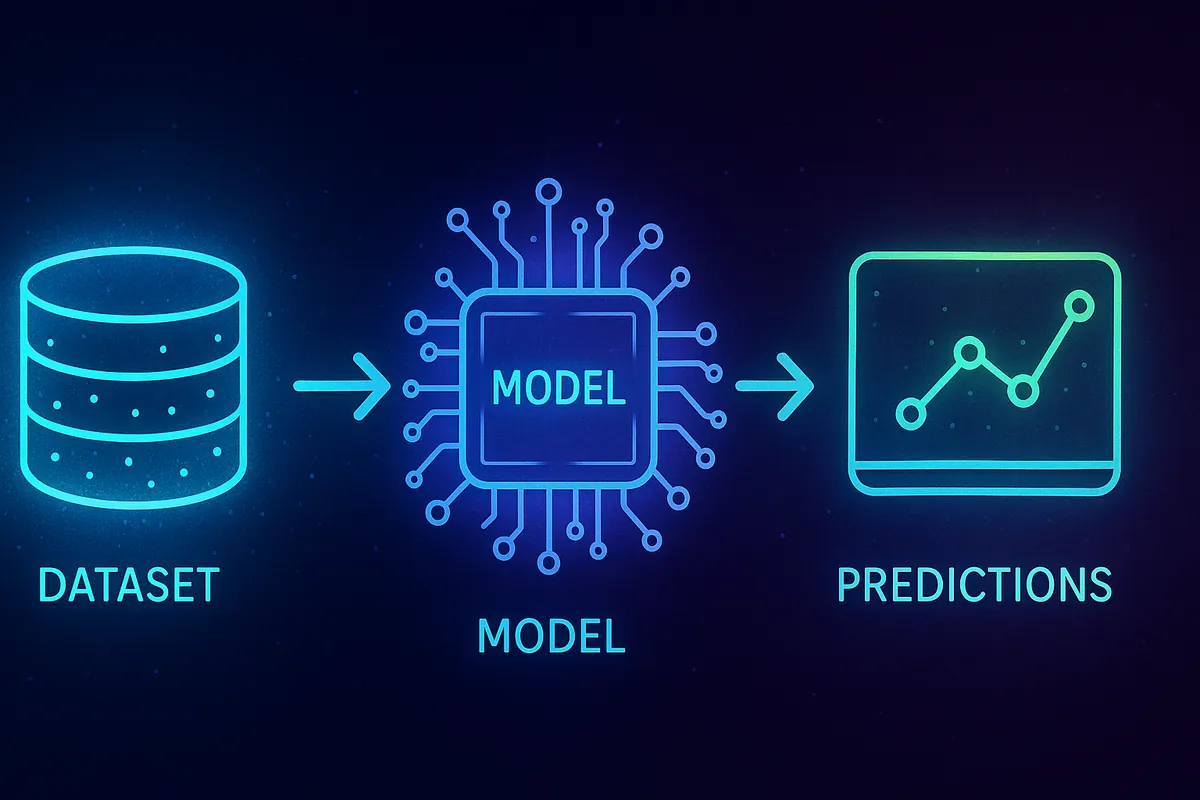
Machine learning offers a different way to construct the filter. Instead of specifying every rule, we supply examples and a procedure for learning a mapping from messages to predictions. We still make many decisions. We have moved some of them into the data and the training process.
What the computer actually learns
For a simple filter, each message can become a row of numbers: whether particular words occur, how many links it contains, or whether the sender has appeared before. These inputs are called features. The training examples also have labels: spam or legitimate.
A learning algorithm adjusts a model using those examples. In a linear model, for instance, words and other features receive weights. A combination associated with spam pushes the prediction in one direction; a combination associated with legitimate mail pushes it in the other.
The computer has not acquired a human understanding of annoyance, fraud, or correspondence. It has fitted a statistical relationship. That relationship can be useful without being anything like a person’s judgment.
There is a practical catch: if the labels are wrong, or the examples come from mail unlike yours, the learned relationship can be wrong in systematic ways. Replacing handwritten rules does not remove the need for judgment. Someone must decide what counts as a good example.
The exam cannot be the answer sheet
Testing the filter on the same messages used to train it tells us too little. A model may capture useful patterns, memorize peculiar examples, or do some of both.
We therefore keep some messages aside and evaluate predictions on them. Even that requires care. If copies of the same spam campaign appear on both sides of a random split, the test may be easier than next week’s inbox. A test using later mail can better resemble that particular future use.
We also need to count the right mistakes. Missing a spam message is irritating. Hiding an urgent legitimate message may be worse. A single overall success rate can conceal that difference.
Training produces the model. Applying it to a new message is inference. An ordinary deployed filter does not necessarily learn every time it makes a prediction; retraining or online updates must be part of the system’s design.
Not every learning problem has a spam label
This example is supervised learning: training includes target answers. In unsupervised learning, a system might group messages with similar wording without being told which are spam. The groups still need interpretation; “similar” does not mean “unwanted.”
Reinforcement learning concerns actions and feedback over time. A program learns a policy from rewards, such as a game-playing agent improving its choices through interaction. Describing all three as “the computer learns by itself” hides the important differences in the feedback we provide.
Machine learning is useful when examples contain regularities that are awkward to express as rules, and when mistakes can be evaluated meaningfully. It is less compelling when a short, stable rule already captures the requirement. A minimum-age restriction does not need to be rediscovered from data.
Before asking which model to use, ask what the examples teach, what the test represents, and which mistake you can tolerate. Those questions determine whether learning will improve the filter—or merely make its failures harder to explain.